How to Run a Cricket Auction for Your Tournament
Every local tournament wants an auction night now. Most of the ones that go wrong go wrong before a single bid is made.
The IPL auction did something to Indian cricket that nobody planned. It turned squad selection into an event. A room, a gavel, a countdown, and forty people finding out in public what somebody thinks they are worth. Every serious local tournament now wants a night like it, and most of them can have one.
What follows is how to actually run a cricket auction. The rules you need to decide before anyone walks in, the maths that quietly ruins auctions when nobody does it, and the moments on the night that separate a good auction from a long argument.
Cricket auction rules to settle before you start
A cricket auction is a rules system pretending to be a party. Get the rules wrong and the party stops halfway through while eight people look up a WhatsApp message from Tuesday.
Four numbers define your auction, and you need all four before you announce it.
- The purse. What each team gets to spend. Rupees if there is real money involved, points if there is not. Points work perfectly well and remove a lot of awkwardness.
- Squad size. The minimum a team must end up with, and the maximum they may hold. The minimum matters more than people expect, for reasons in a moment.
- Base prices. The floor a player can go for. One flat number for everyone is the simplest. Tiered base prices are more interesting and more work.
- The bid increment. How much each raise moves. Too small and the night never ends. Too large and mid-tier players get skipped.
Write these down and publish them before registration opens. An auction rule invented at 9pm on the night, to solve a problem that has just appeared, will be remembered as favouritism whether or not it was.
Purse and base price: the maths nobody does, and everybody regrets
Here is the trap that ruins more cricket auctions than any other, and it is pure arithmetic.
A team has a purse of 1,000 and needs a squad of 11. Base price is 20. Early in the night they fall in love with a batter and go to 700. They now have 300 left and eight places to fill. Eight places at a base price of 20 costs 160, so they are fine. Then they spend 200 on the next player they like. Now they have 100 left, seven places open, and they need 140 to fill them legally.
That team cannot complete a legal squad. Nobody notices until the last set, at which point either the rules bend or a team plays short. Both outcomes poison the tournament.
The fix is a rule you enforce on every single bid: a team's maximum bid is whatever still leaves enough to fill their remaining places at base price. In the example above, with 300 left and eight to fill, the most that team can bid is 300 minus seven times 20, which is 160. Not 300.
Doing this by hand, live, for eight teams at once, while running a room, is not realistic. This is the single strongest argument for running an auction on software rather than a spreadsheet. Skipper caps every team's maximum bid at exactly this number and tells a blocked team why, and how far they could actually have gone, rather than just refusing them.
If you take one thing from this piece: the purse is not what a team can spend. The purse minus the cost of a legal squad is what a team can spend.
Auction sets and player pools, and why the order changes the night
Do not put a hundred players in one list and work down it. The order players come up in is the most underrated lever you have.
Group players into sets: Marquee, Batters, Bowlers, All-rounders, Wicketkeepers, Uncapped, whatever suits your pool. Then think about the sequence.
Open with Marquee. The room is fresh, the purses are full, and the bidding is loud. That is the auction people came to see, and it sets the emotional temperature for everything after it.
Do not put all the wicketkeepers in the last set. If six teams still need a keeper at 10pm, that set becomes a bloodbath, and the four teams already sorted sit bored for twenty minutes. Spread the specialists.
Two things worth adding to a set, if your tool supports them. A price band, so everyone knows roughly what tier they are in. And a per-team cap, limiting how many players one side can take from a single set, which stops one team hoovering up every seamer.
Retention rules, and the owner who does not play
Most local tournaments let teams keep some players from last season. Decide two things.
First, what retention costs. Free retention is simple and heavily favours whoever had a good squad last year. Charging a fixed price against the purse is fairer and takes one line of rules.
Second, whether a retained player uses a squad place. Usually yes. The exception worth carving out is the owner who does not play. Plenty of local teams have someone who funds the side and is on the sheet but never bats. Retaining them should not cost a playing place, and it is worth saying so explicitly rather than arguing about it later.
Mark your captains too. It matters on the night, it matters in the export, and it saves the question being asked nine times.
Player registration and entry fees
The pool is the part organisers underestimate. A player who registers is not necessarily a player who turns up.
Charge an entry fee if you can. It is the single most effective filter against no-shows, and it funds the night. If you collect it in an app rather than by hand, you get the thing that actually saves you: a list of who has paid that you did not build by cross-checking a bank statement against forty names. Skipper handles the refunds too, so a player you reject before approval gets their money back without you remembering to send it — cancellation is always your call, not theirs.
Get every player's role and, where you can, their recent numbers. A team owner bidding on a name with no history is guessing. A team owner looking at a strike rate is bidding.
Running the auction on the night
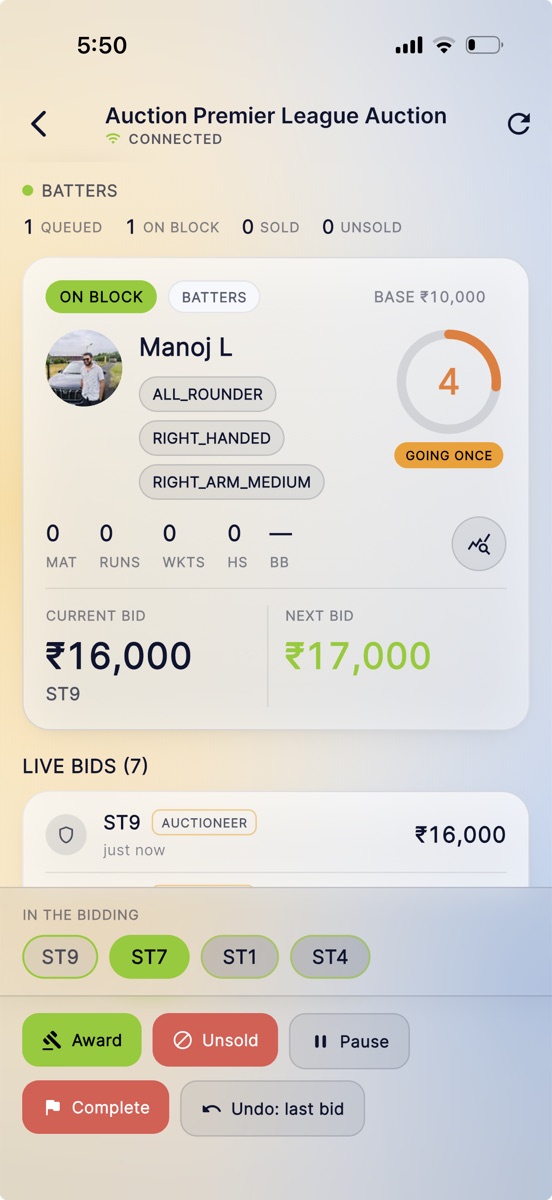
On the night, one person calls the auction and nobody else touches it. This sounds obvious. It is worth enforcing technically as well as socially, because a phone left signed in at home, or a co-organiser trying to help, can and will take over the auction at the worst possible moment.
A few things that keep a night moving:
- A visible clock, that extends on a late bid. A hard countdown creates sniping. An extending one creates drama and fairness at the same time.
- An undo. You will award to the wrong team at least once. Everybody does. Make sure you can take it back without restarting anything.
- A way back into the queue. A player who goes unsold early should be able to come back at the end, when the teams who ignored them have discovered they need a left-arm spinner.
- Search by name. Somebody will shout a name from the back and ask why he has not come up. Being able to find him in two seconds keeps the room with you.
Putting the auction on a projector or live stream
The single biggest upgrade to an auction night costs nothing but a projector and a spare screen. Get the auction out of the auctioneer's hands and onto a wall: the player on the block, the live bid, the purse table, and a card the moment somebody is sold.
It changes the room. People who cannot see what is happening talk over it. People who can see it react to it, and the reaction is the whole point of doing this in the first place. If you are streaming, the same view goes out to the people who could not come.
After the auction: rosters, spend and what to share
Finish properly. Rosters, what each team spent, the top buy of the night, and something shareable per team. An auction that ends with everyone squinting at a spreadsheet on a phone ends flat.
One last piece of advice, learned the hard way by people who run these regularly. Keep a record of who changed what during the weeks before the auction: who moved a player between sets, who altered a base price, who retained whom. On a shared committee account, with three people making changes across a fortnight, "why is his base 250 when we agreed 150" is a question that either has an answer or becomes an accusation. There is no third option.
Do you need a cricket auction app?
Honestly, no. Plenty of good cricket auctions have run on a whiteboard, a spreadsheet and somebody trustworthy with a calculator. If your tournament is six teams and forty players, that will work.
What software buys you is the stuff that is tedious and unforgiving: the maximum-bid maths on every bid for every team, a purse table nobody has to update, a projector view, an undo that is actually safe, and a record of who did what. Those are exactly the things that go wrong at 10pm when the room is loud and everyone is tired.
Skipper does all of it, and setting an auction up is free. If you want to see what the room looks like before committing to anything, the auctions page walks through it.
Cricket auction questions people ask
What is base price in a cricket auction?
The base price is the lowest a player can be sold for, and the figure bidding opens at. Every player has one. You can set a single flat base price for everyone, which is simplest, or tier them so marquee players open higher than the rest.
How is the purse decided?
You decide it. It is the total each team may spend, and it can be in rupees or in points. What matters is that it is the same for every team and published before registration opens. Points are worth considering when no real money changes hands.
How many players can one team buy?
That is your squad size rule, and you need both halves of it: the minimum a team must finish with, and the maximum it may hold. The minimum is the one that does the real work, because it sets the cap on every bid a team makes.
What happens to unsold players?
Most auctions bring unsold players back at the end, once teams know what they still need. A player nobody wanted at 8pm often has three bidders at 10pm when two sides discover they have no left-arm spinner.
How does retention work?
Teams keep an agreed number of players from the previous season instead of putting them back in the pool. Decide what retention costs against the purse, and whether a retained player uses up a squad place. The usual exception is a team owner who does not play.
Is there a free cricket auction app?
Skipper is free to set an auction up on, including the pool, the sets, the purse rules and the broadcast view. Going live requires requesting access in the app, and pricing is agreed with the organiser. Scoring, tournaments and streaming stay free regardless.