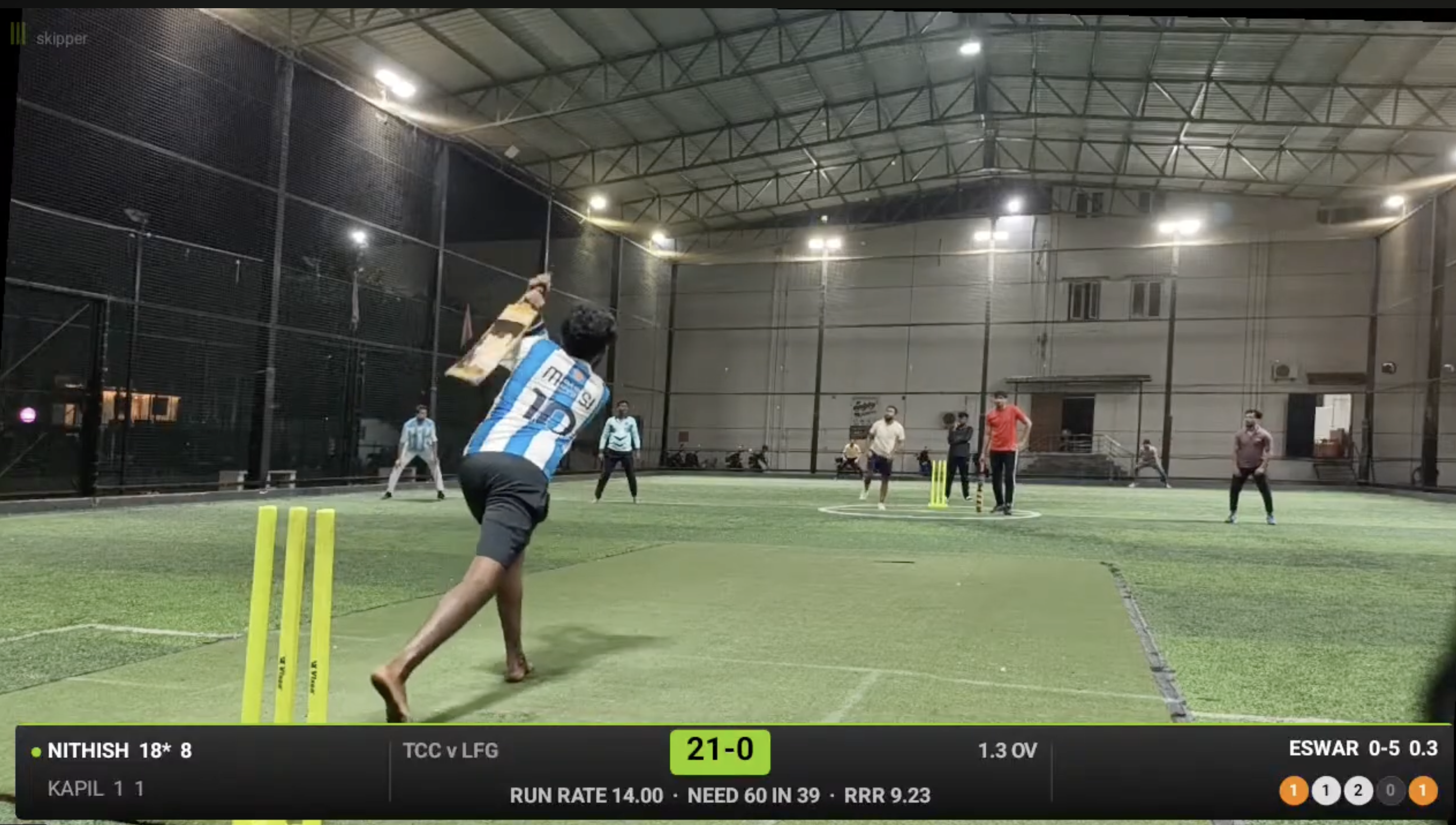
Box Cricket, Scored Properly
Six overs a side, four walls, and a format that most cricket apps quietly treat as a lesser version of the real thing.
Go past any turf in Tiruppur, Coimbatore, Chennai or Bengaluru at ten on a weeknight and there is a game on. Six a side, six overs, tennis ball, floodlights, and twenty people who have come straight from work. Box cricket is now a very large share of the cricket actually being played in India, and almost nobody writes about it.
Part of the reason is snobbery. Part of it is that the tools have not taken it seriously. If you have ever tried to score a box match on an app built for the leather game, you will know the feeling of being asked which end of the pitch a delivery landed on when there is no pitch, only a mat between two walls.
Box cricket rules that break standard cricket scoring
The rules vary from turf to turf, which is itself the first thing any scoring system has to accept. But some things are near-universal, and each one breaks an assumption that standard cricket software makes.
- Walls are in play, or they are boundaries, or they are both depending on which wall. Many turfs score the back net as four and the side walls as live. Some give one bounce off a wall as caught. None of this exists in the laws of cricket.
- Everyone bowls. With six overs and six players, the bowling limit cannot be a fifth of the innings the way it is in a twenty-over game. A rule written for eleven players leaves overs that literally nobody is eligible to bowl.
- The last-man rule. Plenty of box formats let the last batter continue alone, or run in pairs, or bat with a runner. A system that ends the innings at the fall of the fifth wicket is wrong for those games.
- Retirement at a score. Many turfs retire a batter at 25 or 30 to keep everyone involved. That is a retirement, not a dismissal, and it should not show up in anybody's average.
- Nobody is measuring where the ball pitched. There is no pitch map in a box. There is no wagon wheel worth drawing when the field is fifteen metres across and bounded by nets.
What a box cricket scorecard should record
The thing to understand is that box cricket does not need less data than the long form. It needs different data.
What matters in a six-over game is what happens per ball, because there are only thirty-six of them. A dot ball in a six-over match is worth roughly three dots in a T20. Strike rate is close to the only batting number that means anything, and an economy rate of seven is excellent rather than mediocre.
What does not matter is the apparatus built for a longer game. Recording shot type and area, ball by ball, in a format where the entire ground is smaller than a first-class infield, produces charts nobody looks at and slows the scorer down in a game that lasts forty minutes.
We changed this in Skipper recently, and the change was mostly a matter of subtraction. Scoring options now fit the venue and the ball. A box match collects the essentials and nothing extra. A tennis-ball match on a normal ground keeps shot type and area but drops the pitch map. Leather keeps everything. And the analysis screen no longer shows empty charts for things a format was never going to collect, which is the tell-tale sign of software that was designed for one game and pointed at another.
The bowling limit follows the same principle: it is now worked out from the squad size rather than a fixed fraction, so a six-a-side match does not end up with overs that no legal bowler can bowl.
Why score box cricket at all?
Fair question. It is a casual game. People come after work, play, argue, and go home.
Two reasons, and the second is the real one.
The first is that turf owners running regular series need a table. If you run a league across twelve weeks with eight teams, somebody has to keep standings, and a photo of a whiteboard in a WhatsApp group is how disputes start.
The second is that box cricket is, for a lot of people, the only cricket they still play. Somebody who stopped playing league cricket at twenty-four and now plays every Thursday at a turf has a cricket career. It is just one nobody has ever recorded. There is no reason their strike rate over three seasons of Thursday nights should be less real than a schoolboy average from 2009.
That is why box, tennis and turf get their own leaderboards on Skipper rather than being ranked against the leather game. Comparing a tennis-ball average to a red-ball one is meaningless, and putting them in one table makes both numbers useless.
310 editions, and counting
The best argument for taking this format seriously is a series in Tiruppur that has now passed its 310th edition on Skipper.
Three hundred and ten nights of box cricket, scored ball by ball. That is a longer continuous record than most district leagues have, built entirely out of games that a purist would not call proper cricket. The players in it have career stats, form trends, and a points table that has never once been argued about on a whiteboard.
We wrote about that series in more detail here. The short version is that it is the same thing every serious cricket competition is: people who care, turning up regularly, keeping a record.
Running a box cricket league at your turf
A few practical suggestions, whatever you score on.
- Write your rules down once and publish them. Wall rules, retirement scores, last-man rules, bowling limits. Most box cricket arguments are rule ambiguities, not disagreements.
- Score every match, not just the finals. The value of a record is that it is continuous. A season with gaps in it is a season nobody trusts.
- Give the regulars something to look at. A leaderboard is the reason someone comes back for week nine of twelve.
- Do not let the scoring slow the game. Forty-minute matches back to back all evening means the scorer cannot be filling in fields. Two taps per ball, or people stop bothering.
Skipper is free for this, as it is for every other kind of cricket. If you run a turf or a regular series, the tournament guide covers setting up a league table, and the scoring options guide covers matching the app to your format.
Box cricket questions people ask
What are the usual box cricket rules?
They vary by turf, which is the first thing to accept. Common ones: walls in play or counting as boundaries, a retirement score around 25 or 30 to keep everyone involved, a last-man rule, and everyone in the side bowling. Write yours down and publish them, because most box cricket arguments are rule ambiguities rather than disagreements.
How many overs is a box cricket match?
Most box formats run five to eight overs a side, commonly six, with five to eight players. The short format is why per-ball detail matters more than in the long game: a dot ball in a six-over match is worth roughly three in a T20.
How many overs can one bowler bowl in box cricket?
A limit written as a fixed fraction of the innings does not work when the side has six players rather than eleven, and leaves overs nobody is eligible to bowl. The limit should come from squad size. Skipper works it out that way and lets you set overs per bowler yourself.
Is there a free app to score box cricket?
Skipper scores box, tennis-ball and turf cricket free, with scoring options that fit the format rather than asking for pitch maps a box court does not have. Box, tennis and turf also get their own leaderboards rather than being ranked against the leather game.